Kitchen design
Kitchen design in Cyprus, and what actually decides it
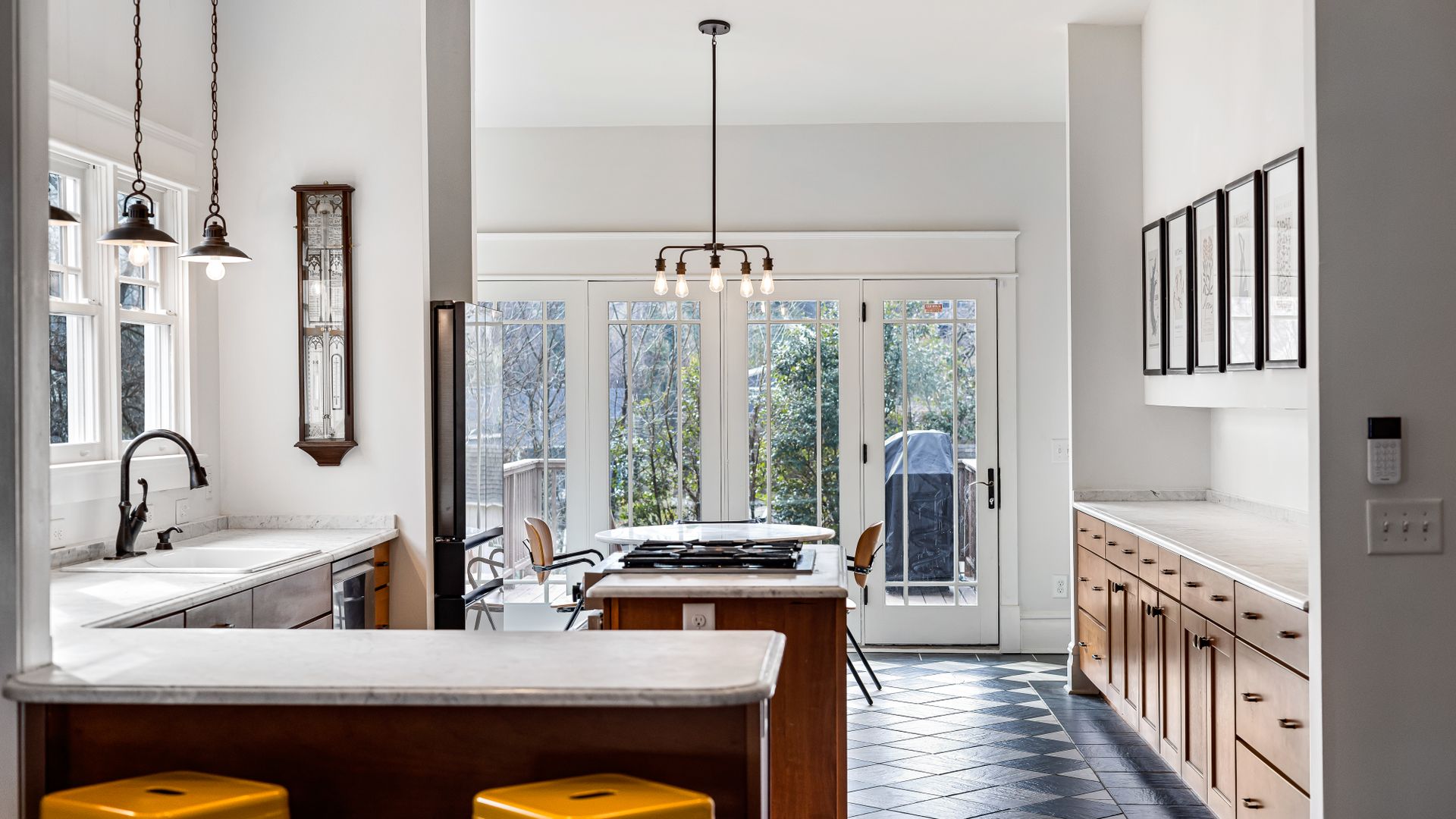
Kitchen design for Cyprus homes: layouts that suit the light and the heat, materials that last, and where the budget goes.
7 min read
Stavros covers the rooms that carry the most cost per square metre and the finishes that go into them. He tracks the order trades have to arrive in, which moves a Cypriot renovation bill further than any hourly rate does.
Published
A kitchen in Cyprus is settled by three things long before anyone chooses a door front: what the wall behind the units is made of, where the extraction can physically go, and how hard the afternoon sun lands on the worktop. Those three decide the layout, the material list and most of the cost. Style follows them, and a kitchen that ignores them looks tired within a few summers regardless of what was spent on it.
The Mediterranean constraint
Cypriot housing is mostly reinforced concrete frame with blockwork infill. That matters on day one, because it splits every wall in a kitchen into two categories: infill that can come out with a structural engineer's note, and frame that cannot come out at all. Much of the flat stock in Strovolos and the comparable Nicosia suburbs dates from the 1970s to the 1990s, and in that stock rewiring and replumbing dominate renovation work. A kitchen there is rarely a cabinet job. It is a services job with cabinets fitted afterwards.
The second constraint is the plan those flats were drawn to. The kitchen almost always adjoins a covered service balcony carrying the washing machine, often the boiler, and the waste stack. Everything wet has to fall back to that stack, and a sink moved to the far side of the room leaves a long, shallow waste run — the commonest source of a slow drain in a newly finished kitchen.
Then the light. A worktop on a west-facing run takes direct sun through the hottest part of the afternoon for most of the year, and surface temperatures there are nothing like what a European specification sheet assumes. The same sun loads the room, which is why an oven and a fridge on one warm wall is a fight nobody wins.
Two site conditions decide the ironmongery list. Within a few hundred metres of the sea — Kato Paphos is the clearest case — the air carries salt continuously, and galvanised or marine-grade fixings are standard rather than an upgrade. Inland, the issue is dust, which a matte finish forgives and high gloss does not.
What works here
Ducted extraction, run short and straight. Extraction to outside air removes grease, steam and heat. A recirculating hood filters odour and returns the heat to the room — the wrong trade where frying and grilling are routine. Plan the duct route before the layout is frozen, because in an apartment a new facade penetration involves the shared parts of the building and the management committee.
Cool storage away from the hot wall. Put the fridge and any wine storage on the coolest wall available, ideally north or internal. Condensers work harder in a warm room, and failures cluster in units backed onto a sun-loaded wall.
Pale, dense worktop surfaces. Sintered porcelain slab and granite behave well under heat and hard light. Engineered quartz works, but its resin binder is the vulnerable part under prolonged ultraviolet, so keep it off unshaded west and south runs or shade the glazing above. Cypriot limestone and travertine are lovely underfoot and poor as a worktop — porous enough that lemon juice and olive oil leave a record.
Moisture-resistant carcasses, edged on all four sides. Board tolerates the humidity swing of an air-conditioned kitchen in August far better when no raw cut edge is exposed, particularly under the sink and around the dishwasher. Near the coast, specify A4 (316) stainless or PVD-coated handles and taps rather than chrome plating, which pits slowly enough that nobody connects it back to the specification.
A route to outdoor cooking. Much Cypriot cooking moves outside from late spring, and it keeps the heat out of the house. Designing for that means a door that works with hands full, a socket and a water point outside, and drainage.
Warm, layered light. Under-cabinet task light on the working surfaces, and a warm colour temperature rather than the cool white that suits a northern winter. A north-facing window over the sink, which reads as a compromise in a British brief, is an asset here: steady light, no glare, no heat.
A supply check before induction. Induction hob, oven, dishwasher and air conditioning on an older block's incoming supply is a real question. The Electricity Authority of Cyprus publishes what a connection provides; a registered electrician confirms what the consumer unit can carry.
What does not travel
Some of the most photographed ideas in kitchen design were developed for a climate Cyprus does not have.
Open shelving as the main storage strategy. It works where windows stay shut and the air is clean. Here it collects a dust film within days, and everything on it has to be washed rather than wiped.
High-gloss white lacquer with push-to-open fronts. Gloss shows that dust plus fingerprints, and a handleless front is touched on its face by definition. Textured matte or fine-grain melamine hides both and cleans faster.
Plumbed ice and water in a large fridge. Cyprus mains water is hard. Scale accumulates in the feed line, the filter and the ice mechanism, and the repair is rarely economical. The same applies to boiling-water taps unless filtration is designed in from the start.
Solid timber worktops. The seasonal humidity swing, indoor air conditioning and direct sun move timber more than the oiling schedule assumes.
Dark cabinetry across a west-facing run. It absorbs heat and radiates it back into the room in the evening, and it shows dust as clearly as gloss does.
A brand with no service presence on the island. Imported appliances are quick to specify and slow to repair when the nearest spare is a freight booking away.
Extraction ducted into a ceiling void. It moves the grease and moisture somewhere else in the building rather than out of it, and the consequences appear in the ceiling above, months later.
Materials and where to get them
Those figures are read from our own price index when the page loads, so they do not quietly go out of date. What moves a project within the range is predictable: whether services move, whether the cabinetry is local or imported, the worktop material, and how square the existing room is.
There are two supply routes on the island. Local joinery workshops — in the industrial zones around Nicosia, and in Limassol and Paphos — build carcasses and fronts to measured sizes, which is the better answer in older masonry flats where an off-the-shelf module leaves a filler panel every metre. Imported German and Italian systems arrive through the Limassol showrooms with tighter hardware tolerances and longer lead times, and suit new-build villas where the openings are true.
Stone and porcelain fabricators template after the carcasses are physically in place. Insist on that order. A slab cut from a drawing in a building where nothing is square is the most expensive avoidable mistake in a Cypriot kitchen, and it is made regularly.
Access shapes delivery more than people expect. On the hillside plots around Peyia, steep roads limit crane and vehicle size, which can mean a worktop split into two pieces with a visible joint — a design-stage decision, not a delivery-day one. Work in Polis Chrysochous carries travel time from the Paphos contractor base in most quoted day rates. And in seasonal accommodation such as Ayia Napa, refurbishment concentrates in the November to March window, so fabricators are booked hardest exactly then.
Our kitchen design section covers the room type in more depth, the services pages set out what each trade delivers, and the area pages describe how building stock and access differ by district. Where the work removes a wall, alters the facade or reroutes drainage, an ETEK-registered architect or civil engineer should be involved before anything is demolished, and the Department of Town Planning and Housing decides what needs consent.
Common questions
Do I need a permit to redesign a kitchen in Cyprus?
Replacing units, worktops and appliances within the same layout normally does not. It changes once a wall moves, a new opening is cut in the facade for extraction or a window, or the drainage route alters. In an apartment, work touching the structure or the shared parts also involves the management committee. The Department of Town Planning and Housing sets out what requires consent.
How long does a kitchen take from design to handover?
The lead item decides it. Locally made cabinetry can start as soon as first fix and plaster are done; imported systems are ordered months ahead while the site waits. The worktop, which cannot be templated until the carcasses are standing, adds a fabrication period on top. Ask the fitter for the two dates that matter: cabinetry delivery, and templating.
Is a kitchen island always a good idea?
Only if the services can reach it. An island sink needs a waste run with adequate fall back to the stack, and an island hob needs an extraction route — through the floor or via a ceiling unit, both structural questions in a concrete-frame building. Straightforward in a villa on a ground slab; often the reason a first-floor flat quietly becomes a peninsula.
What goes wrong most often?
Two things. Extraction designed after the layout, which ends in a recirculating hood nobody wanted; and a worktop templated from a drawing rather than from the fitted carcasses. Both are settled on paper and expensive to correct afterwards.
Sources
- Cyprus Scientific and Technical Chamber (ETEK) — registered engineers and architects — retrieved 2026-07-28
- Department of Town Planning and Housing — planning and building control — retrieved 2026-07-28
- Electricity Authority of Cyprus — supply and connection information — retrieved 2026-07-28
Where to go next
Companies, districts and the rest of the guides on this subject.

Thinking of doing this?Get up to five quotes, free.
Tell us about the room and we will put you in touch with designers who know the light here.