Interior design
Bathroom design in Cyprus
Design guidance for bathroom in Cyprus: what works in this light and heat, and what the material choices tend to cost.
7 min read
Elena covers interior design, furniture and lighting for Cypriot homes. Her focus is the gap between a scheme drawn for a northern European climate and one that survives this light, this heat and, near the coast, this salt.
Published
A Cypriot bathroom is decided by three things that never appear in a mood image: how the water gets hot, where the soil stack runs, and whether the wet area was tanked before it was tiled. Everything else — the stone, the format of the tile, the brassware finish — sits on top of those, and a scheme that gets them wrong looks correct on handover and fails within two summers.
A strip-out to finished, standard three-piece, is published at €3,500 to €9,500 per room, median €5,800. The width of that range is not finish quality. It is whether the pipework is being moved, whether the block is old enough that opening a wall means replacing what is behind it, and how much of the room is being tanked.
| Work | Indicative range | Midpoint | Published sources |
|---|---|---|---|
| Bathroom renovationComplete bathroom refit as a whole-project price, not per m². Low end is a 3–5 m² cosmetic refresh (new tiles, basin, WC, paint); mid level is a 5–8 m² full refit with walk-in shower, vanity, new plumbing and electrics; high end is an 8 m²+ wet-room conversion with freestanding bath, premium tile and underfloor heating. Excludes VAT. | €3,000–€30,000per bathroom | €9,000 |
Indicative range compiled from published sources, not a quote. It shows the level those sources report for this kind of work, not what your job costs. Only a site visit and a written quote for your actual scope produce a real figure. Sources compiled 2026-08-02.
The Mediterranean constraint
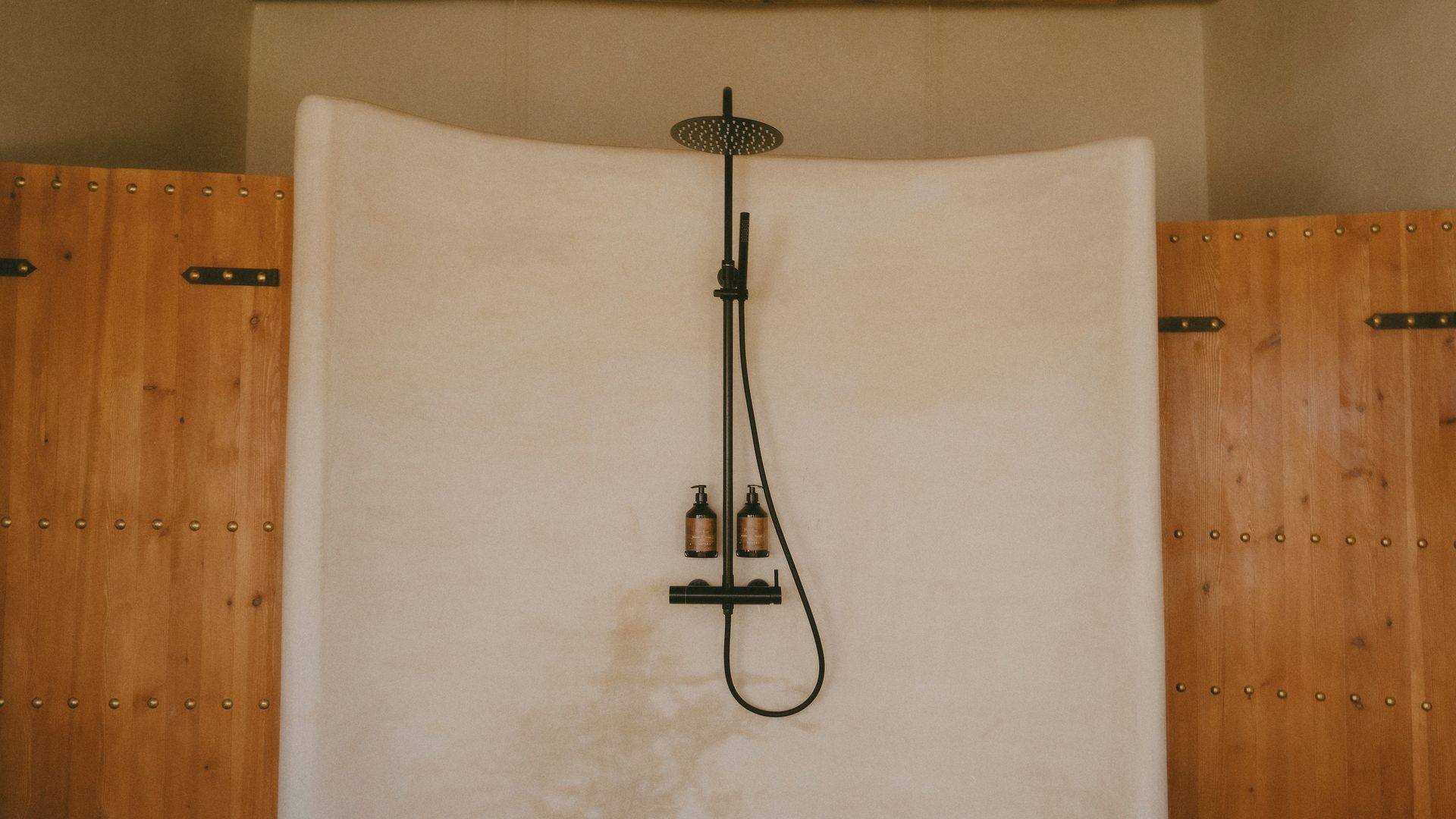
Hot water in Cyprus mostly arrives from the roof. A thermosiphon solar cylinder of 150 to 200 litres, installed, is published at €700 to €1,400, median €950, and it is the reason two Cypriot bathrooms with identical fittings can behave completely differently. Gravity-fed solar cylinders deliver low pressure. A rainfall head and a thermostatic mixer specified from a European catalogue assume mains pressure and will disappoint on a gravity system unless a pump is designed in from the start. That single decision governs the shower, and it belongs at concept stage, not at second fix.
The second constraint is the building. In the 1970s to 1990s apartment blocks that dominate districts such as Strovolos, replumbing is the dominant renovation activity, and replacing galvanised or early plastic pipework is published at €40 to €100 per square metre, median €62. In those blocks the soil stack is usually shared and boxed into a corner, which fixes where the WC can go far more firmly than any layout drawing.
The third is humidity and salt. Around Oroklini, proximity to the salt lake raises humidity enough that damp-proofing specifications change, and injected course plus replastering is published at €25 to €75 per square metre, median €42. On the seafront at Kato Paphos, salt-laden air makes galvanised and marine-grade fixings standard — which matters for concealed cistern frames, shower screen brackets and any exposed fixing in a room that is ventilated by an open window.
Cyprus also has an unusual bathroom advantage worth using: for much of the year a bathroom can be ventilated naturally. That does not remove the need for mechanical extract, because the months when the window stays shut are exactly the months when the air conditioning is running and the room dries slowest.
What works here
Tanking the whole wet zone, not the splash zone. A tanking membrane taken up the walls and across the floor of the shower area, with taped corners and pipe collars, is what keeps water out of the slab. Waterproofing is published at €18 to €45 per square metre, median €28, for a two-coat liquid membrane, though the recorded scope there is a flat roof — in a bathroom the tanking is normally priced inside the room figure. The line to look for on a quote is the membrane by name, not the word "waterproofing".
Large-format porcelain with a proper fall. Wall and floor tiling in standard formats, with the substrate already prepared, is published at €18 to €48 per square metre, median €28. Large tiles mean fewer grout lines to discolour, and in a wet room the entire cost of the exercise is the accuracy of the falls to the drain.
Stone that suits the water. Travertine and local limestone read correctly in a Cypriot bathroom and need a penetrating sealer and a pH-neutral cleaner. Hard water is the deciding factor: on marble and limestone, limescale and acidic cleaners together will etch a polished surface, so a honed finish is the more durable choice.
A linear or wall-hung layout on a shared stack. Wall-hung sanitaryware on a concealed frame keeps the floor clear for cleaning and lets the falls be set without chasing the slab. It works with a shared stack rather than against it.
Mechanical extract ducted to outside. Not into a void, not into a ceiling plenum. Certified electrician time is published at €32 to €65 per hour, median €45, and an extract fan wired to run on after the light is among the cheapest things in the room.
What does not travel
Rainfall showers on unpumped gravity solar. The most common single disappointment in a Cypriot bathroom refit, and entirely avoidable at design stage.
Freestanding baths in a small apartment bathroom. They need floor area, access all round for cleaning, and a hot water volume a domestic solar cylinder may not comfortably supply in winter.
Unlacquered brass and blackened steel near the coast. Both are prominent in current bathroom writing. In a seafront flat with salt in the air and hard water in the pipes, they mark quickly. Inland, in Nicosia or a village house, they are a reasonable choice.
MDF vanity carcasses. In a room that runs humid for months, moisture- resistant board or a marine-grade substrate is the difference between joinery that survives a decade and joinery that swells at the plinth.
Micro-mosaic on a shower floor. It looks precise and it puts several metres of grout in the wettest part of the room. A single large tile cut to the fall, or a resin tray, gives less to maintain.
Underfloor heating as the default. In most Cypriot bathrooms it is a comfort item for a short stretch of the winter. It is defensible inland, where the temperature range is widest, and hard to justify in a coastal flat.
Materials and where to get them
Sanitaryware, brassware and shower enclosures come through importers in Limassol and Nicosia. Stock lines are quick; a specific European catalogue item is not, and in a bathroom that matters more than elsewhere because the first fix cannot be completed until the exact fittings are known. Concealed cistern frames and shower trays are the usual culprits for holding up a trade sequence.
Tile and stone split the same way. Locally quarried limestone and island fabricators keep the shortest lead time and the lowest risk of a batch mismatch on a second delivery; imported porcelain in a stock format is straightforward, and a special format is not. Any stone should be ordered from one batch, with the offcut for the vanity top taken from the same slab.
Labour is sequenced rather than bought. Plumber time is published at €30 to €60 per hour, median €42, materials extra, and the bathroom trade order — strip out, first fix, tanking, screed, tile, second fix — does not compress. Where a designer is coordinating that sequence as part of a wider scheme, full design service is published at €35 to €130 per square metre, median €65. The interior design and service pages on this site set out what each stage covers.
Where the hot water system is being replaced at the same time, a support scheme may apply.
Common questions
Does a bathroom refit need planning permission in Cyprus?
Replacing fittings, tiling and joinery in the same positions does not. Altering the structure, moving a soil stack outside the building, or changing the external appearance does, and in an apartment block the management regulations normally require consent of their own for anything touching shared services.
What moves a bathroom from €3,500 to €9,500?
Relocating the WC and the stack, the extent of tanking, tile format, and what is found behind the wall in an older block. Fittings matter least of the four. A room where the layout is kept and only the surfaces and fittings change sits near the bottom of the range; a room where the services move sits near the top before anything is chosen.
Is a wet room a good idea in a Cypriot apartment?
It can be, provided the floor build-up allows a fall to the drain without raising the threshold awkwardly, and provided the tanking is specified as a membrane system rather than as a coat of paint. In an older block with a shallow screed, a low-profile tray is often the more reliable answer.
What finish survives hard water best?
Chrome and brushed stainless, followed by PVD finishes. Lacquered surfaces are fine indoors and away from salt. On the coast, anything specified as marine-grade or galvanised will outlast a decorative finish chosen for its colour.
When should the work be scheduled?
Spring and autumn suit occupied homes, since a bathroom out of use is easier to absorb outside the hottest months and screeds cure more predictably. For holiday lets in the eastern resort areas the window is set by the season, which concentrates refurbishment into November to March.
Sources
- ETEK — Cyprus Scientific and Technical Chamber — retrieved 2026-07-28
- Department of Town Planning and Housing — planning permission — retrieved 2026-07-28
- Ministry of Energy, Commerce and Industry — solar water heater replacement support — retrieved 2026-07-28
Where to go next
Companies, districts and the rest of the guides on this subject.

Thinking of doing this?Get up to five quotes, free.
Tell us about the room and we will put you in touch with designers who know the light here.