Interior design
Mediterranean, minimalist or coastal — comparing interior directions in Cyprus
Mediterranean, minimalist, coastal or village rustic in a Cypriot house: what each is made of, what it costs to keep, and which one the building decides.
8 min read
Elena covers interior design, furniture and lighting for Cypriot homes. Her focus is the gap between a scheme drawn for a northern European climate and one that survives this light, this heat and, near the coast, this salt.
Published
The choice between a Mediterranean scheme and a minimalist one is settled by the building far more often than by taste. A rendered blockwork house with deep reveals, small openings and masonry thermal mass behaves like a Mediterranean interior whether or not anyone decides it should. A seafront tower with floor-to-ceiling glass and plasterboard linings does not, and dressing it in lime plaster and reclaimed beams is money spent fighting a structure that will win.
Four directions account for almost every residential brief on the island. They differ less in appearance than in what they are made of, and material is what decides how a room looks in year eight rather than on handover day.
The options
1. Mediterranean. Warm mineral surfaces used honestly: lime or clay plaster, local limestone, terracotta and unglazed terrazzo underfoot, solid timber in iroko, cedar or olive, and a palette of bone, sand, buff and ochre. Openings are treated as heat problems first — external louvred shutters, deep reveals, pergolas. It assumes eight months of hard light and a house made of masonry.
2. Contemporary minimalist. Flat white or off-white walls, large-format porcelain, handleless sprayed joinery, concealed lighting, few materials repeated everywhere. Detailing does the work texture does elsewhere, so tolerances are tighter and the trades have to be better.
3. Coastal. The blue-and-white register: painted or limed timber, rattan and cane, cotton and linen in white and indigo, rope, glazed ceramic. In Cyprus this is holiday-let language more than resident language, because it installs fast, refreshes cheaply and reads instantly in a listing photograph.
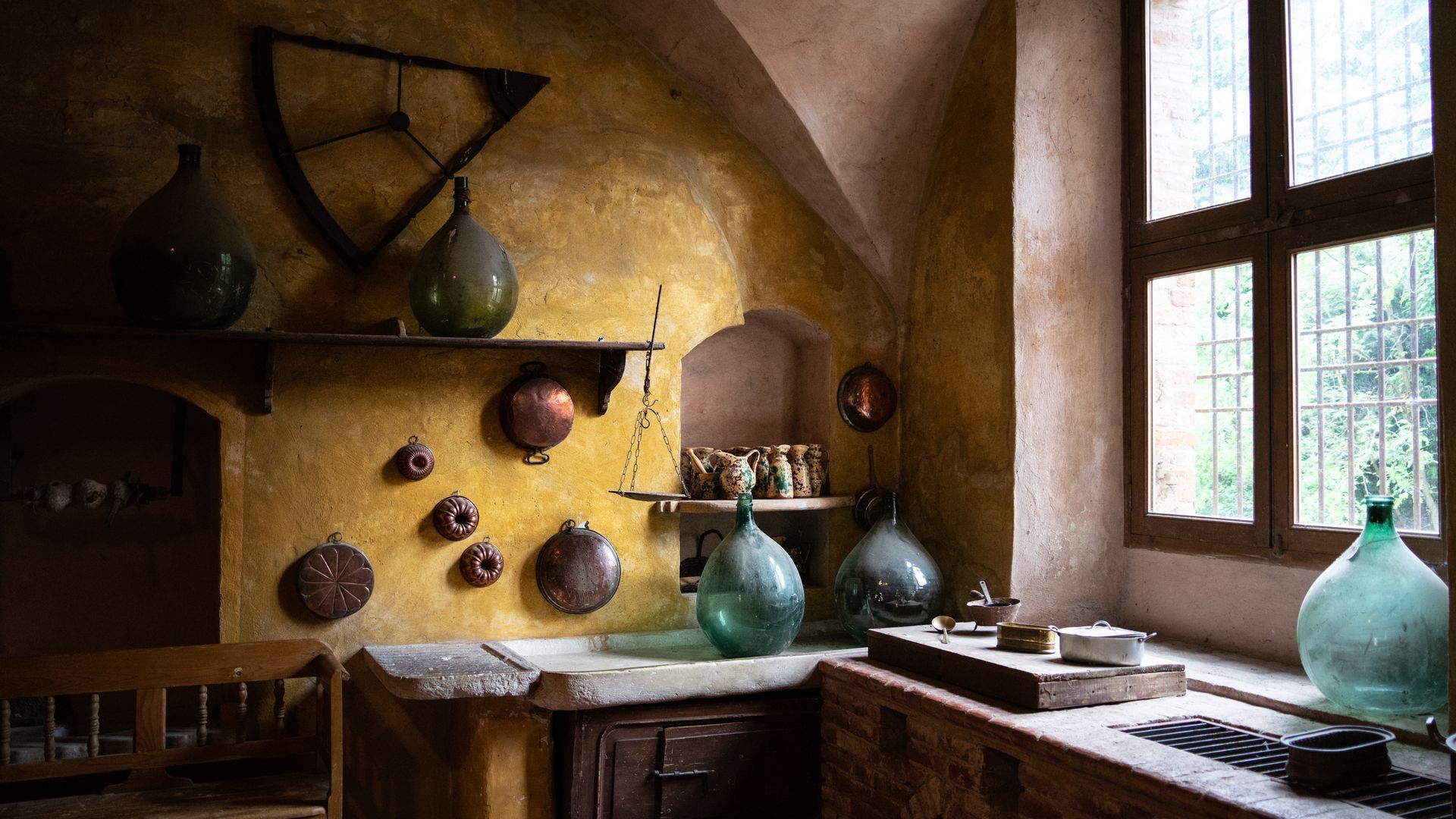
4. Village rustic. The traditional Cypriot interior kept rather than recreated: exposed stone, timber ceiling structure, arched openings, existing mosaic or terrazzo floors, iron and copper. Budget goes into conservation — repointing in lime, repairing joinery — rather than into new finishes.
The palette, finishes schedule and joinery drawings for any of the four come under a single design fee charged on floor area, running about €35 to €130 per square metre island-wide with the middle near €65.
| Work | Indicative range | Midpoint | Published sources |
|---|---|---|---|
| Interior designInterior designer's fee per m² of the space being designed, not the cost of building or furnishing it. Covers layout options, 3D visualisation, material and finish schedules, furniture and lighting specification and working drawings. Low end is a basic design-only package on a project of 50 m² or more; single rooms and small flats are charged nearer €100/m² because of the fixed base effort, and premium studios with full project supervision reach €100–200/m². One Cypriot studio adds 20% for projects under 100 m². | €30–€200per m² | €50 |
Indicative range compiled from published sources, not a quote. It shows the level those sources report for this kind of work, not what your job costs. Only a site visit and a written quote for your actual scope produce a real figure. Sources compiled 2026-08-02.
Side-by-side comparison
| Mediterranean | Minimalist | Coastal | Village rustic | |
|---|---|---|---|---|
| Core materials | Lime plaster, limestone, terracotta, solid timber | Porcelain, sprayed MDF, plasterboard, glass | Painted timber, rattan, cotton, glazed ceramic | Existing stone, structural timber, terrazzo, iron |
| Under Cypriot light | Designed for it; textured mineral surfaces break up glare | Unforgiving — flat white goes blue-white at midday and shows every plane defect | Strong in bright rooms, flattens under artificial light | Excellent, because materials and light come from the same place |
| Salt and dust | High tolerance; surfaces are repairable | Low on details — sprayed edges chip, plated ironmongery pits | Mixed; cane and rope degrade, paint is easy to redo | High, given lime rather than cement is used |
| Where money goes | Materials, and trades who can lay them | Substrate preparation and joinery tolerance | Soft furnishings and loose items | Repair labour and specialist masonry |
| Repair after damage | Patch and re-limewash, invisible | Replace the panel, usually the whole run | Replace the item | Piecemeal, by a mason |
| Main risk | Cement render sold as lime; the wrong terracotta sealant | Good drawings executed by trades who cannot hold the tolerance | Dating quickly and reading as generic | Damp or structure discovered once finishes come off |
The row that decides most projects is repair after damage. A chipped lime plaster wall is a morning's work with a bucket. A chipped sprayed door in a discontinued colour is a new door, and usually a new run, because a sprayed finish matched three years later almost never matches.
The second is where the money goes. Mediterranean and rustic schemes buy materials with published rates — porcelain supplied and laid runs roughly €22 to €70 per square metre, stone facing on blockwork €85 to €260, two coats on prepared interior walls €6 to €15. Minimalist schemes buy joinery, where custom units with a sprayed finish sit between about €320 and €1,100 per linear metre, set by the spray shop rather than by the carcass.
| Work | Indicative range | Midpoint | Published sources |
|---|---|---|---|
| FurnitureBudget for furnishing a two-bedroom apartment in Cyprus from empty, covering living area, bedrooms and dining. Low end is a basics-only fit-out from value retailers; the mid figure is the budget cited for a comfortable mid-range setup in Limassol or Paphos. Delivery is quoted separately at €50–150 to the main cities and up to €300 to Paphos and Troodos, with assembly at €100–500. | €8,000–€20,000per 2-bedroom apartment | €15,000 |
Indicative range compiled from published sources, not a quote. It shows the level those sources report for this kind of work, not what your job costs. Only a site visit and a written quote for your actual scope produce a real figure. Sources compiled 2026-08-02.
Which suits which property
1970s to 1990s apartment blocks in Strovolos and the older Nicosia suburbs. Rewiring and replumbing dominate renovation in this stock, so the walls are being opened and reskimmed regardless. That favours minimalism, because a flat, well-prepared substrate is exactly what it needs. A Mediterranean scheme here adds texture to a building that has none — possible, but decoration rather than continuity.
Seafront and high-rise Limassol. Rapid high-rise development has pushed demand towards balcony waterproofing and facade maintenance, and the interior implication follows: this is a glass-and-slab building. Warmth comes from timber joinery, wool and linen, not from added plaster and stone — mass on a slab is a structural question, not a finishes one.
Coastal Paphos, including Kato Paphos. Salt-laden air is why galvanised and marine-grade fixings are standard specification, and the rule holds indoors. Ironmongery, track brackets, hinges and lighting fixings corrode from the terminals outward within sight of the sea. Mediterranean and coastal directions absorb this; a minimalist scheme detailed in plated brass does not.
Hillside plots around Peyia. Steep access roads cap delivery vehicle size, which quietly caps the size of a one-piece porcelain slab, a full-height mirror or a single-span joinery run. Confirm the approach before a slab is ordered.
Inland Nicosia. The widest temperature range on the island drives shading and insulation, and the Mediterranean approach treats those as design decisions rather than engineering afterthoughts. Deep reveals, external louvres and pale mineral surfaces do measurable work here.
Stone village houses and designated traditional settlements. Village rustic is usually the only sensible direction, and partly a compulsory one: external materials and colours are controlled in designated settlements, and the Department of Town Planning and Housing holds the designations. Internal finishes are freer, but anything touching structure, openings or external appearance needs a professional entitled to sign for it, and ETEK holds that register.
Holiday lets in Protaras and Ayia Napa. Refurbishment concentrates into November to March because rooms are full the rest of the year. Coastal wins on programme rather than merit: it installs inside a short closure window and refreshes item by item without taking the property offline again.
Polis Chrysochous, the Troodos villages and anywhere far from the trade base. Distance adds travel time to quoted day rates, and it multiplies for directions needing repeat specialist visits. A lime plasterer making four trips to Polis costs materially more than the same work in Paphos town.
Cost over ten years
Over a decade the ranking changes, and not because of inflation.
Mediterranean is mid-cost to install and the cheapest to hold. Lime and clay surfaces are patched rather than replaced, terrazzo is re-polished, timber is re-oiled. There is a small recurring maintenance line and almost no replacement line. The expensive mistake is sealing terracotta with a film-forming product, which traps moisture and eventually means stripping the floor.
Minimalist has the widest ten-year spread of the four, because it is a finishes-quality bet. Done by a good spray shop on a properly prepared substrate, it holds for a decade on repainting alone. Done cheaply, edges chip in year two and the repair is never a patch — it is a run. The direction is not expensive; doing it badly is.
Coastal is cheapest to install and most often refreshed. Assume two refreshes in ten years, more in a let property — manageable when planned as a cost, an irritation when it was sold as a one-off.
Village rustic is the most expensive to begin and the flattest afterwards. The outlay is repair labour, and once the fabric is sound the line is close to horizontal. Its risk sits at the start: strip-out reveals what the previous forty years did, and a contingency that was never held is a project that stops.
Two costs sit outside all four. Anything altering external appearance or structure — and in an apartment block, anything the management regulations cover — is a permission question before it is a design one. And a scheme that never names the concealed metal near the coast is paid for twice: once at installation, once when the fixings behind the plaster stain through it.
The subject pages here cover the finish-level detail behind each material choice, and the regional pages set out how the answer shifts between a Troodos stone house and a Limassol apartment. Designers who have completed work in each direction are listed on our practitioner site with their projects visible.
Common questions
Is Mediterranean design just minimalism with texture?
No, and the difference is structural. Minimalism reduces the number of materials and relies on precision to carry the room. A Mediterranean scheme accepts irregularity — a lime wall is not meant to be flat — and relies on mass, shade and surface. Applied to the same room they produce different plans, not just different finishes: one wants uninterrupted planes, the other wants thickness.
Which direction suits a property that will be let?
Coastal, or a restrained Mediterranean scheme, for the same reason: both are repairable during an ordinary maintenance visit between guests. A minimalist interior fails on damage economics in a let property, because guest damage to a sprayed finish is a replacement rather than a touch-up, and the property is offline while it happens.
Does a Mediterranean interior actually reduce cooling costs?
The internal finishes make a marginal difference. What makes a measurable one is the part of the approach that sits at the opening — external shading, reveal depth, reflective external surfaces — because those intercept solar gain before it passes the glass. Pale internal surfaces help with lighting load and perceived brightness rather than with heat.
Can the directions be mixed?
Mix at the level of the room rather than the surface. A minimalist kitchen with a Mediterranean living space reads as deliberate because each room is internally consistent. One plaster wall in an otherwise minimalist room reads as an afterthought, because the detailing at the junction gives it away.
What is the most common specification mistake?
Cement where lime belongs. Cement render on stone or older masonry traps moisture the wall was built to release, and the damage shows as spalling and salt bloom years later, well after the contractor has gone. It is the one error here that is expensive to reverse rather than merely visible.
Sources
- Department of Town Planning and Housing — planning zones and traditional settlements — retrieved 2026-07-29
- Cyprus Scientific and Technical Chamber (ETEK) — registered professionals and technical guidance — retrieved 2026-07-29
Where to go next
Companies, districts and the rest of the guides on this subject.

Thinking of doing this?Get up to five quotes, free.
Tell us about the room and we will put you in touch with designers who know the light here.